A data-led look at housing pressure, semigration, tourism, and why simple villains don’t solve complex cities
Cape Town currently has approximately 23,564 to 26,870 Airbnb listings, depending on data source and season. That figure often anchors public debate — but on its own, it explains very little.
To understand Airbnb’s role in Cape Town, we need to separate legitimate concern from simplified causation.
The concern is real — and deserves respect
Cape Town faces a deep housing crisis rooted in long-standing structural realities:
-
spatial apartheid and distance from work opportunities
-
limited availability of well-located land
-
slow delivery of affordable housing
-
rising construction and finance costs
For many residents — especially working-class Capetonians who need to live close to jobs — affordability pressure is acute. Any serious discussion must start here.
Demand matters: semigration and employment pressure
Housing pressure in Cape Town is not only a supply problem; it is also a demand-driven one.
The city continues to attract:
-
semigration from other provinces
-
international buyers and returnees
-
people relocating in search of basic employment opportunities in services, tourism, logistics, healthcare, and construction
Cape Town is not a city only for the wealthy. A significant share of inward migration is driven by people seeking work at income levels that already struggle to access well-located housing. This demand places sustained pressure on the rental market regardless of short-term rentals.
Affordable housing exists — but delivery lags demand
The City has a stated pipeline of approximately 12,000 affordable housing units across 21 land parcels, including:
-
±2,741 social housing rental units (under ±R7,326 per month for households earning below ±R22,000)
-
±916 gap housing units
-
±683 open-market affordable homes
However, progress on several sites has been slow due to:
-
relocation complexities
-
funding approvals
-
planning and procurement timelines
Projects such as Salt River illustrate the gap between policy intent and on-the-ground delivery — during which demand continues to rise.
Airbnb is part of the system — but not the whole system
Short-term rentals do affect housing supply in specific neighbourhoods, particularly where tourism demand is concentrated and zoning allows flexible use. But several distinctions matter:
-
Not every Airbnb listing represents a removed home. Listings include private rooms, seasonal properties, owner-occupied homes, and dual-use listings.
-
Many short-term rentals were never viable long-term housing, due to size, price point, location, or owner usage.
-
Ownership concentration exists — but varies widely and requires transparent, local data, not global generalisations.
A critical spatial mismatch
Homes typically suitable for Airbnb — by price, location, and typology — are not located in the areas where Cape Town’s housing shortage is most severe.
Short-term rentals are concentrated in:
-
coastal and high-amenity zones
-
established middle- to upper-income suburbs
-
areas that were never affordable to begin with for households most affected by displacement
This does not mean short-term rentals have no impact — but it does mean they are unlikely to be the primary driver of exclusion in lower-income housing markets.
International comparisons require care
Cities such as Barcelona and Berlin are frequently cited, but Cape Town differs materially in:
-
urban density and land availability
-
social housing stock
-
tourism seasonality
-
historical spatial inequality
International examples can inform risk awareness, but they cannot substitute for local analysis grounded in South African realities.
Tourism also creates livelihoods
Short-term rentals support a broad employment ecosystem:
-
cleaners, housekeepers, and supervisors
-
maintenance teams and artisans
-
security, laundry, transport, and hospitality services
For many households, this income is immediate and essential. Any assessment that ignores employment effects tells only half the story.
Regulation should be targeted, not symbolic
The real question is not whether Airbnb is “good” or “bad.”
It is:
-
where short-term rentals genuinely displace housing
-
where they coexist with mixed-use neighbourhoods
-
how vulnerable residents can be protected without collapsing economic activity
Effective regulation is:
-
data-driven
-
neighbourhood-specific
-
transparent
-
enforceable
Blanket bans and emotionally charged narratives may generate headlines, but they rarely resolve complex urban problems.
A note to journalists
This is not a culture war between hosts and residents.
It is a layered housing, planning, and economic challenge.
Responsible reporting distinguishes:
-
correlation from causation
-
global analogy from local data
-
political framing from policy outcome
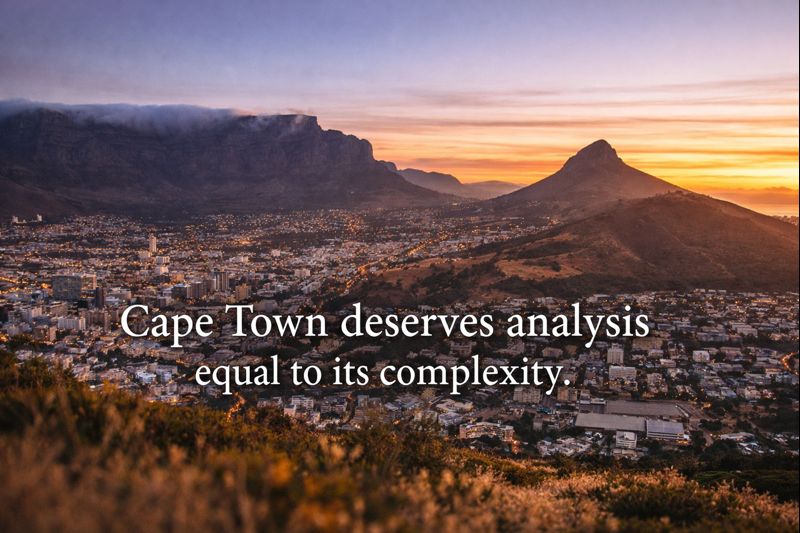
Cape Town deserves analysis equal to its complexity.