


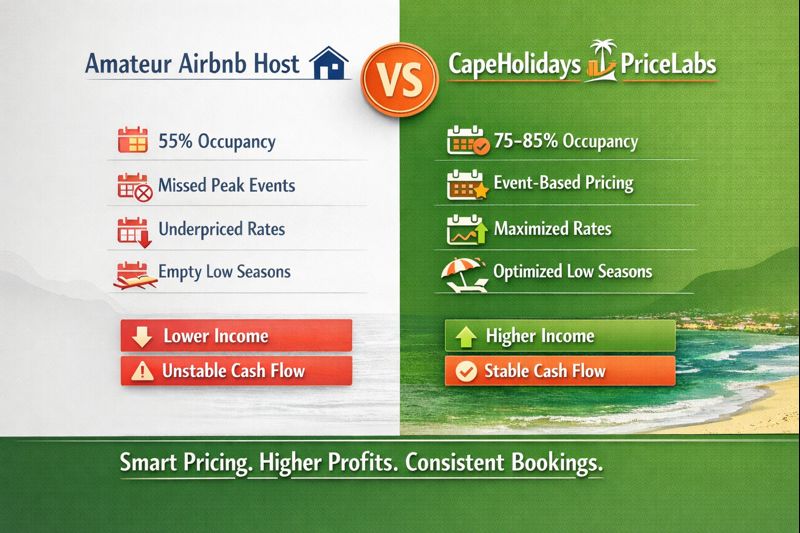
And how it increases homeowner income in Cape Town
Most Airbnb owners believe the game is simple:
List the home, pick a nightly rate, and hope it stays booked.
That mindset is exactly why the average Airbnb host only achieves around 55% occupancy across a year — even in strong markets like Cape Town.
At CapeHolidays, we rejected that model long ago.
Before PriceLabs, our “Wower” properties already averaged ~75% occupancy, well above the market. But occupancy alone does not equal profit — and that’s why we adopted PriceLabs.
Because net income comes from the right price on the right night — not from being cheap or constantly full.
The real problem: static pricing destroys income
Most non-professional hosts use:
• Airbnb Smart Pricing
• A fixed nightly rate
• Or occasional manual tweaks
These systems react slowly, don’t understand local micro-markets, and don’t track booking behaviour across thousands of comparable listings.
The result is predictable:
| Typical Host | Professional Revenue Management |
|---|---|
| ~55% occupancy | 70–85% occupancy |
| Flat or guessed pricing | Market-responsive pricing |
| Missed peak nights | Captures peak demand |
| Underpriced high-demand dates | Maximised ADR |
| Random discounting | Strategic yield management |
The average host doesn’t lose money because they are bad hosts.
They lose money because their pricing system is blind.
Why CapeHolidays adopted PriceLabs
We didn’t choose PriceLabs because it’s trendy.
We chose it because it allows us to do what professional hotel revenue teams have done for decades:
Sell every night at the highest price the market will bear.
PriceLabs gives us:
• Live market demand from thousands of nearby listings
• Event-based pricing (concerts, festivals, holidays, peak travel weeks)
• Seasonality curves for Cape Town, not generic averages
• Forward-looking occupancy and pickup data
• Automatic daily price optimisation
• Minimums, base rates and yield controls
• Demand-driven discounts instead of blanket markdowns
This allows us to balance two critical drivers of income:
Occupancy × Average Daily Rate = Revenue
Most hosts focus on only one.
What changed when we added PriceLabs
Before PriceLabs, our “Wower” homes were already doing around 75% occupancy — because we curate exceptional homes and manage them professionally.
But here’s the hidden problem:
When demand surged, we were still underpriced.
When demand softened, we weren’t discounting precisely enough.
PriceLabs fixes both.
Now:
• High-demand nights price higher automatically
• Soft demand gets smart, targeted discounts
• Long-lead bookings don’t block peak pricing
• Short-lead demand gets captured
• Events, seasons and travel patterns are reflected daily
This means we can now:
Increase nightly rates in peak periods
And
Protect or even increase occupancy in off-peak periods
That is how revenue compounds.
Why this matters for homeowner net income
Owners often focus on:
“How much was my nightly rate?”
The real question is:
“How much did my home earn over 12 months?”
A property at 55% occupancy with poor pricing will always lose to one at 75–85% with dynamic pricing — even if the second one has higher nightly rates.
PriceLabs allows us to:
• Avoid underpricing during peak demand
• Avoid overpricing during low demand
• Reduce empty nights
• Increase average revenue per booking
• Improve annual yield
That is how net income grows — not by guessing, not by copying neighbours, and not by racing to the bottom.
Why CapeHolidays owners win
CapeHolidays combines:
- Curated, high-quality homes
- Professional hosting & guest experience
- Revenue management using PriceLabs
- Local Cape Town market intelligence
- Daily optimisation, not set-and-forget pricing
Most agencies do one or two of these.
We do all five.
The bottom line
If you are priced like an amateur,
you earn like an amateur.
PriceLabs allows us to run your home like a boutique hotel, not a casual Airbnb.
That is why we use it.
That is why our owners outperform the market.
And that is why CapeHolidays exists.