


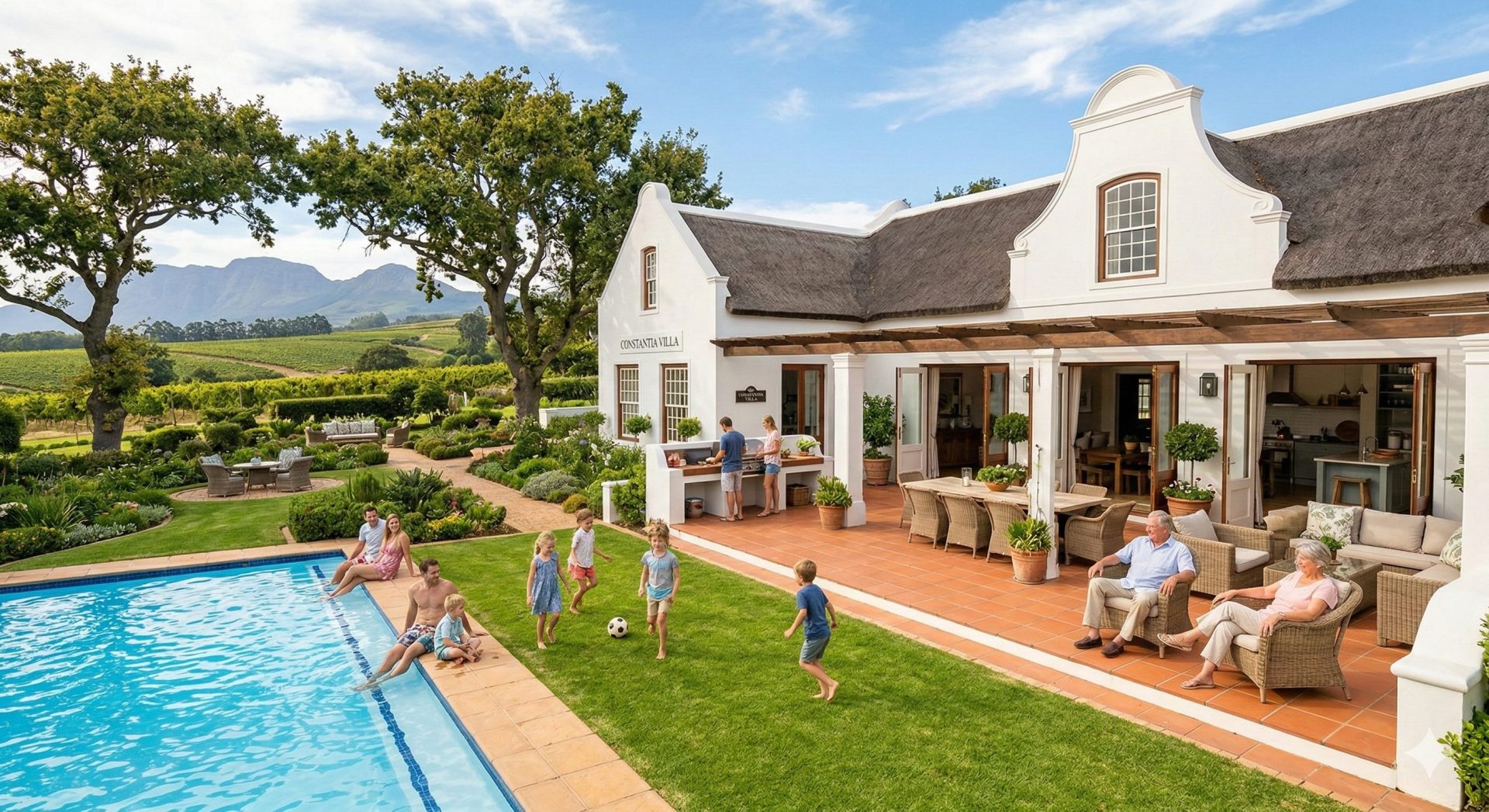
What extended families should understand before choosing how — and where — to live together in Cape Town.
Introduction: When “Villa” Is the Wrong Starting Point
The phrase Cape Town villas for multigenerational families is often interpreted as a search for size: more bedrooms, more bathrooms, more amenities. For families travelling across generations, however, the success of a shared stay rarely depends on scale alone.
In Cape Town, villas behave very differently depending on geography, layout, and how they accommodate daily family dynamics. A property that appears generous on paper can quickly feel restrictive if circulation, privacy, or environmental factors are misaligned with how an extended family actually lives.
For multigenerational travel, the decision is not about finding the “best” villa. It is about choosing a living structure that supports independence, togetherness, and comfort across age groups — without friction.
Understanding Multigenerational Family Dynamics
Multigenerational stays involve overlapping but distinct needs. Grandparents often prioritise ease of movement and quiet. Parents manage routines and logistics. Teenagers seek autonomy. Younger children need safety and containment.
What creates tension is not proximity, but forced proximity — layouts that require everyone to operate on the same schedule or navigate the same circulation routes throughout the day.
The most successful multigenerational villas allow:
-
separation without isolation
-
shared spaces without congestion
-
autonomy without disconnection
This is where structure matters more than square metres.
Horizontal vs Vertical Living: The Defining Structural Choice
One of the most overlooked considerations when choosing Cape Town villas for multigenerational families is whether a home functions horizontally or vertically.
Horizontal Living: Separation by Distance, Not Height
In Cape Town, many properties in Constantia and Bishopscourt tend to be more horizontal in nature. Large plots and estate-style development allow homes to spread across a single level or gently arranged wings, often with gardens acting as natural buffers between spaces.
These layouts typically offer:
-
minimal reliance on stairs
-
bedrooms separated by distance rather than floors
-
easier movement for elderly guests and young children
-
a calmer, more intuitive daily flow
For multigenerational families, horizontal homes often feel immediately workable. Privacy is achieved through layout rather than elevation, reducing friction during unstructured parts of the day.
Vertical Living: Separation by Floors
By contrast, many villas along Bantry Bay, Clifton, and mountain-side Atlantic Seaboard neighbourhoods are more vertical. Built into steep slopes to maximise views, these homes often involve multiple storeys, internal staircases, and stacked living zones.
Vertical living can provide strong separation between generations, but it also introduces complexity:
-
daily reliance on stairs
-
concentrated living areas that require convergence
-
reduced visual connection between age groups
These homes can work well for families comfortable managing vertical circulation, but they require more deliberate room allocation and daily planning.
Area Context: How Geography Shapes Family Living
Constantia and Bishopscourt: Horizontal Ease and Estate Rhythm
These areas are characterised by space, greenery, and containment. Villas here often sit on large erven with gardens, pools, and multiple zones that support different activity levels simultaneously.
They suit families who:
-
value ease of movement
-
prefer outdoor garden space over coastal exposure
-
prioritise privacy and routine
The trade-off is distance. Access to beaches and city attractions requires planning, and stays here tend to be inward-facing rather than socially visible.
Atlantic Seaboard: Vertical Living with Coastal Exposure
Mountain-side Atlantic Seaboard areas offer proximity to the ocean and the city, often paired with dramatic outlooks. The vertical nature of many homes reflects this terrain.
For families, this can mean:
-
impressive views with more complex circulation
-
stronger separation between floors
-
increased sensitivity to wind, sun, and seasonal conditions
These areas reward families who value outlook and proximity, but they demand tolerance for stairs, exposure, and daily movement patterns.
Daily Rhythm: Where Friction Usually Appears
Multigenerational stays rarely fail during planned activities. Friction most often appears during:
-
early mornings
-
late afternoons
-
mealtimes
-
rest periods
Vertical homes tend to concentrate kitchens and living areas on a single level, requiring everyone to converge repeatedly. Horizontal homes distribute activity more naturally, allowing overlap without collision.
Environmental factors amplify this effect. Heat, wind, and sun exposure can render certain spaces unusable at key moments, increasing pressure on remaining shared areas.
Who This Works For / Who It Doesn’t
This works well for:
-
Families travelling with grandparents or mobility considerations
-
Groups with mixed energy levels and independent routines
-
Longer stays where comfort and rhythm matter more than novelty
-
Families who value autonomy alongside shared time
It is less suitable for:
-
Families expecting hotel-style service within a private home
-
Groups uncomfortable with shared responsibility for space and flow
-
Stays where all guests expect identical schedules and usage patterns
Local Insight: Why “Bigger” Often Means Harder
A common miscalculation is assuming that a larger villa automatically solves multigenerational complexity. In Cape Town, larger homes are often more vertical, not more functional.
A well-designed horizontal estate in Constantia or Bishopscourt frequently outperforms a larger, view-driven vertical villa when it comes to lived comfort across generations. This distinction is rarely apparent in photographs or listings, but it becomes obvious within the first days of a stay.
Understanding how a home behaves is more valuable than knowing how many bedrooms it has.
Conclusion: Fit Over Footprint
There is no universal definition of the ideal Cape Town villa for multigenerational families. What works depends on how a family moves, rests, gathers, and separates throughout the day.
Horizontal versus vertical living is not an architectural preference — it is a behavioural one. The right choice supports independence without isolation, togetherness without pressure, and comfort without compromise.
In multigenerational travel, luxury is not defined by size or address. It is defined by how effectively a home supports the way a family actually lives together.
A Curated Approach
For families seeking carefully matched villas rather than navigating public listings, CapeHolidays provides discreet guidance and curated introductions via trusted local operators, focusing on layout, context, and lived experience rather than surface appeal.